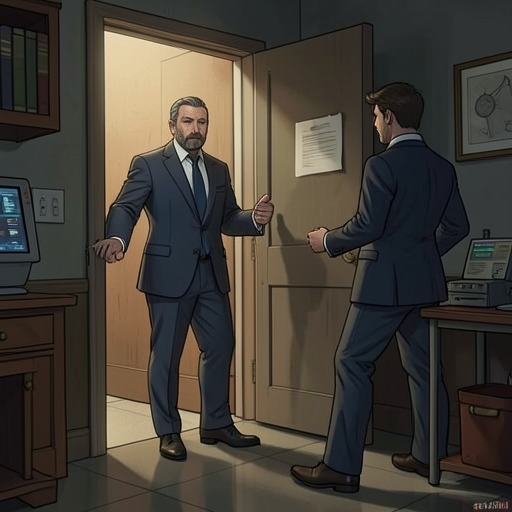
Fran Revell
Panic RoomFran Revell is a solicitor whose professional competence is repeatedly tested by private obligations. Formerly married to Don Challenor and now married to Peter Revell, she handles the sale of Mona Jackson’s Cornish house, Wortalleth West, under pressure from Jack Harkness, to whom she owes a debt. The assignment draws her into Don’s investigation and places her between competing loyalties; when she disappears, her professional connection to Harkness becomes a matter of personal danger, and her eventual freedom depends on his payment of a ransom.
Identity and Background
Fran and Don have remained on cordial terms in business since their divorce. Don remembers their separation as more sorrowful than angry, and their old familiarity survives in meetings marked by wary affection as well as friction. Fran’s choice to meet him at a nearby coffee shop rather than at her office signals that their contact is personal as well as professional, though Don’s optimism leads him to treat the setting as merely informal. Their marriage had been damaged by his habit of pushing his luck, a pattern that remains visible in their exchanges after the divorce.
Fran has since built a family life with Peter and two daughters. That household, however, is under strain: when she prepares to travel to Cornwall, Peter and Fran have had a tense weekend, and the girls have been difficult. Peter does not know the full extent of Fran’s obligations to Harkness. He understands the trip as a straightforward work assignment, while Fran knows that her family’s financial history complicates it. The difference between what her household believes and what she must manage makes her outwardly practical role a cover for a more precarious situation.
The Wortalleth West Assignment
Fran asks Don to value a property in Cornwall and prepare the materials needed to present it to suitable agents: a valuation, floor plans, photographs, and related particulars. The expected price is about five million pounds, aimed at the international market. Don immediately sees the possible commission in selling it himself, but Fran initially limits his role to assembling the sales material. Her assignment is tied to a divorce and to a woman seeking a prompt sale; the property is Mona Jackson’s, although its owner’s connection to Harkness is initially confused by the fact that their divorce is not yet final. Fran clarifies that Mona is the sole owner.
The commission is not simply an ordinary property sale. Harkness has helped Fran’s family through a financial crisis connected to Peter’s gambling addiction, which Peter claims to have conquered. Fran has been obliged to repay Harkness, and the nature of that obligation shapes what she can safely do. When Don is later recruited by Amos French to seek information about money Harkness has allegedly hidden, French points to Fran’s recent meetings with Harkness and suggests that her loyalties may be divided. He offers Don money for useful information and instructs him to keep him informed, making Fran’s private dealings part of a wider contest over Harkness’s affairs.
Fran’s judgment of the property assignment is shaped by her awareness that the house contains a panic room. She expects Don’s report of a discrepancy in the building’s dimensions may lead Robin Pawley, the photographer and measurer, to notice it. Her intended response is to tell Pawley to disregard the discrepancy and continue preparing the sales particulars. She believes he will comply, in part because she is paying him enough and regards him as more amenable to instruction than Don. The plan shows how she tries to contain an irregularity through professional management, even as the concealed feature makes the task more than a routine sale.
Pressure, Disappearance, and Captivity
Fran’s work in Cornwall proceeds under time pressure. She travels on the Sunday-night sleeper, sees the house, and meets Pawley. She tells Peter that matters are going smoothly and spends Monday night at the Polurrian Bay Hotel. In a Tuesday morning call, she says she will return her hire car and catch the 4.40 train from Truro to London, due into Paddington at 9.30. Instead, she misses her appointment with Pawley, cannot be reached by phone, fails to return the car on time, and does not board the expected train or the one after it. The planned business trip abruptly becomes a disappearance that leaves both her family and colleagues without an explanation.
The account of her disappearance gives way to evidence of captivity. Amos French answers Don’s call using Fran’s phone, and later lets her speak to him. Her voice is hoarse and strained; she asks whether it is Don and begins to tell him that if there is anything he knows, a plea that links her confinement to the investigation without resolving what she has learned or what she wants him to do. French’s use of her phone turns an ordinary point of contact into proof that he controls access to her. Fran is no longer merely a suspected source of information about Harkness; she is a captive whom French can use to press Don.
Release and Narrative Significance
Fran’s release comes after Harkness arrives at the yard where she is being held. Zlenko unlocks her handcuffs and helps her from the chair, his formal, almost courteous manner sharply at odds with her captivity. Harkness is waiting beside a bright red Mercedes convertible that Fran recognizes as Coleman’s, carrying a canvas holdall. He tells her a deal has been made and that she is free to go. When she sees the cash in the bag and asks whether he has paid for her release, he confirms that he has paid handsomely. The scene establishes both the immediate consequence of the deal and the leverage Harkness retains through money.
Fran’s plot role rests on the gap between her professional identity and her compromised freedom of action. She arranges valuations, schedules a sale, and tries to keep Pawley from pursuing a suspicious discrepancy; at the same time, debt makes her dealings with Harkness difficult to separate from coercion, and French treats those dealings as a route to information. Her disappearance exposes the danger of that position, while her release through a cash payment shows that Harkness can act as both the source of her obligation and the person who secures her freedom. The available account resolves her immediate captivity, but leaves her broader financial and personal entanglements unresolved.